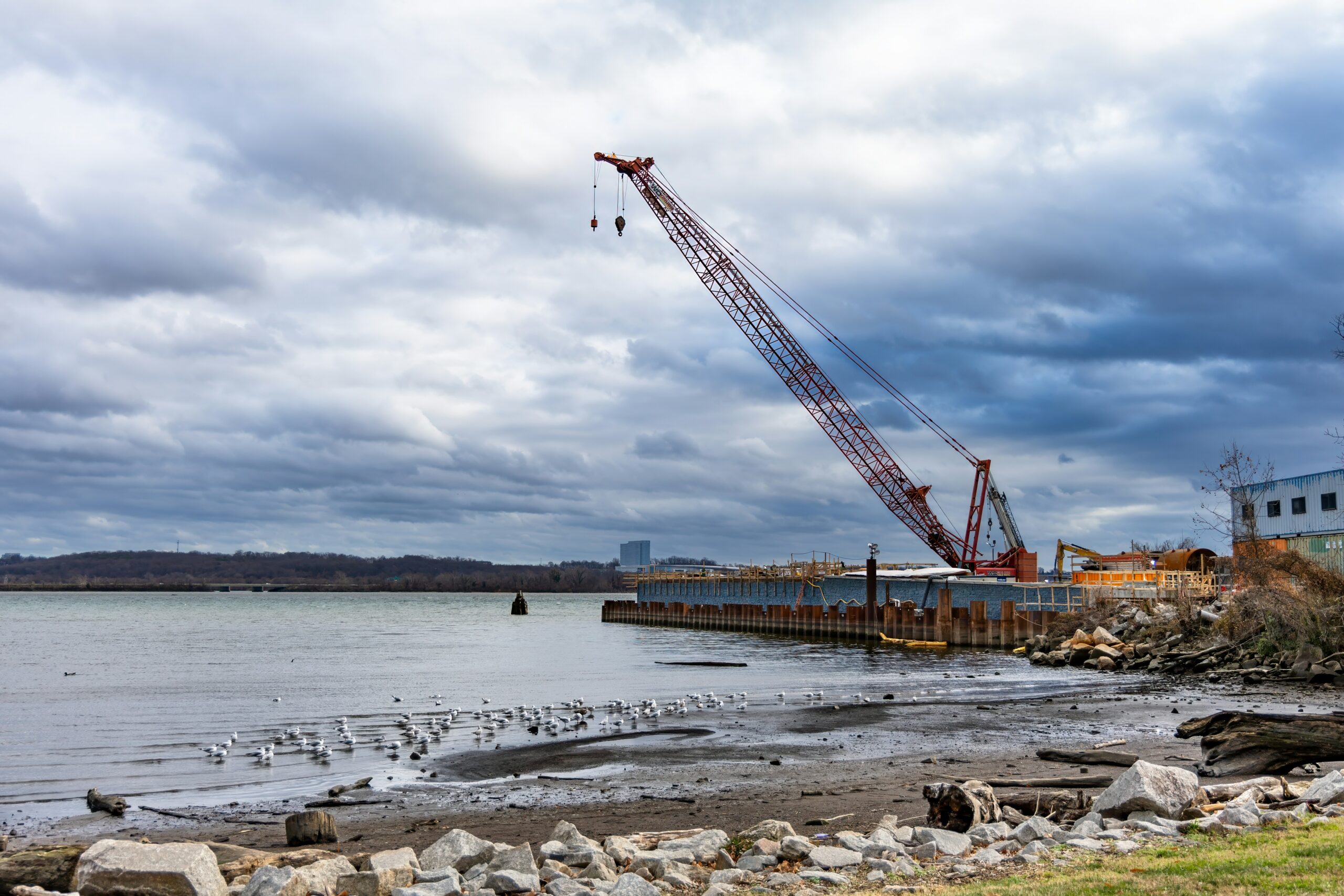
Marine construction pushes engineering into places where land-based rules no longer apply. Projects must survive moving water, shifting seabeds, salt exposure, powerful storms, and difficult access. For engineers and contractors, successful marine engineering depends on understanding these forces before construction begins. Every pier, offshore platform, seawall, bridge foundation, and underwater structure must work with the surrounding environment rather than simply resist it. That challenge makes construction on the water one of the most demanding areas of modern engineering.
Why Marine Construction Is So Challenging
A construction site on land usually offers a relatively stable working surface. Marine construction rarely provides that advantage. Water moves constantly, while waves, tides, currents, and changing weather can affect both temporary operations and permanent structures. The seabed creates another challenge. It may consist of rock, dense sand, soft clay, loose sediment, or several layers of different materials. Engineers need to understand these conditions because the seabed often supports enormous structural loads. Access can also become complicated. Workers may need barges, floating cranes, diving teams, specialized vessels, or remotely operated equipment. A task that takes a few hours on land might require careful planning over several days offshore. Extreme environments increase these difficulties. High waves can stop crane operations. Strong currents can limit underwater work. Cold conditions can affect workers and machinery. Meanwhile, remote locations can make replacement parts, fuel, equipment, and emergency support harder to obtain.
Engineering for Waves, Tides, and Currents
Water creates dynamic loads that can change from one moment to the next. Therefore, engineers cannot design marine structures around normal conditions alone. They also have to consider severe events that may occur during the structure’s service life. Waves can create repeated forces against piles, platforms, breakwaters, and seawalls. Over thousands or millions of cycles, these forces can contribute to fatigue in structural components. Currents can create continuous lateral pressure while also moving sediment around foundations. Tides introduce another variable. A structure may experience changing water levels several times during a construction operation. As a result, crews often schedule certain activities around tidal windows. Modern marine design uses site measurements, historical records, numerical models, and engineering analysis to estimate these loads. Engineers can then determine appropriate dimensions, foundation systems, materials, and protective measures.
Foundations Below the Waterline
Foundations are among the most important parts of any marine structure. They transfer loads into the seabed while resisting movement caused by waves, currents, vessels, wind, and other forces. Pile foundations are common because long steel or concrete members can reach stronger soil layers below weaker surface sediments. Depending on site conditions, contractors may drive, drill, or install piles using other specialized methods. Other projects may use gravity-based foundations, caissons, anchors, or large concrete structures. The correct solution depends on water depth, soil conditions, structural loads, environmental requirements, and available construction equipment. This is where offshore engineering becomes closely connected with geotechnical investigation. Engineers may use boreholes, soil sampling, cone penetration testing, geophysical surveys, and laboratory testing to understand the seabed before finalizing a design. Poor knowledge of seabed conditions can create expensive problems later. Unexpected rock, weak soil, buried debris, or unstable sediment can delay installation and force design changes. Therefore, early investigation can reduce uncertainty before heavy equipment arrives.
The Hidden Problem of Scour
Even a strong foundation can become vulnerable when moving water removes sediment around it. This process is known as scour. When water flows around a pile or other obstruction, the flow pattern changes. Local turbulence can increase near the foundation and carry seabed material away. Over time, this can expose more of the foundation than designers intended. Engineers may reduce scour with rock placement, protective mattresses, specially designed foundation shapes, or other seabed protection systems. Monitoring can also help operators detect changes before they threaten structural performance. Scour deserves attention because much of the damage happens underwater and remains invisible from the surface. A structure may appear normal while significant changes occur around its foundations.
Fighting Corrosion in Saltwater
Saltwater is highly aggressive toward many construction materials. Steel structures face particular risks because exposure to seawater and oxygen can accelerate corrosion. Engineers use several strategies to manage the problem. Protective coatings create a barrier between steel and the environment. Cathodic protection systems can reduce electrochemical corrosion. Designers may also include additional material thickness so that limited corrosion can occur without reducing the structure below its required capacity. Concrete requires careful design as well. Marine concrete can experience chloride penetration, reinforcement corrosion, cracking, and other forms of deterioration. Proper concrete mixtures, adequate reinforcement cover, controlled cracking, and suitable protective systems can improve durability. Material selection is especially important in the splash zone, where components repeatedly become wet and dry. These areas can experience severe exposure and may require stronger protection than permanently submerged sections.
Building During Severe Weather
Extreme weather affects more than the finished structure. It also changes how construction itself must be planned. Floating cranes and work barges have operational limits. High winds, large waves, or strong currents may make lifting unsafe or prevent vessels from maintaining position. Contractors therefore establish acceptable weather windows for critical operations. Planning is especially important when a task can’t be stopped easily halfway through. Installing a major offshore component, placing concrete, towing a large structure, or completing a heavy lift may require several hours of suitable conditions. Weather forecasting now plays an important role in these decisions. Project teams can combine marine forecasts with real-time measurements from the site. However, forecasts cannot eliminate uncertainty. Construction plans still need contingency procedures for changing conditions.
Specialized Equipment for Marine Projects
Marine construction relies on equipment designed to operate where conventional land machinery cannot. Jack-up barges can provide stable working platforms by extending legs down to the seabed. Floating cranes allow crews to lift massive components from barges or transport vessels. Dynamic positioning systems can help certain vessels maintain location without traditional anchoring. Underwater operations may involve commercial divers, remotely operated vehicles, sonar equipment, cameras, and specialized cutting or installation tools. Increasingly, remote systems can inspect areas that are difficult or dangerous for divers to reach. The equipment selected for a project can strongly influence its design. Engineers must consider crane capacity, vessel dimensions, water depth, port access, transportation limits, and installation methods early in the planning process.
Safety When the Worksite Is Water
Marine projects introduce hazards that are uncommon on normal construction sites. Workers may face vessel movement, slippery surfaces, open water, suspended loads, changing weather, underwater operations, and limited evacuation options. For that reason, safety planning needs to cover both construction hazards and marine operations. Communication between vessel crews, crane operators, engineers, divers, and construction teams is especially important. Emergency planning also changes offshore. A medical incident at a remote location may require transportation by boat or helicopter. Severe weather could delay evacuation. Teams must therefore prepare procedures, equipment, and communication systems before work begins.
Protecting the Marine Environment
Construction in water can disturb sensitive ecosystems. Pile installation may generate underwater noise. Dredging can release suspended sediment. Vessel activity can affect marine wildlife, while accidental spills can damage surrounding habitats. Environmental planning often begins before construction. Surveys can identify sensitive species, habitats, migration periods, water-quality concerns, and other site-specific issues. Contractors can then adjust construction methods accordingly. Projects may use sediment controls, noise-reduction techniques, carefully planned work periods, spill-prevention systems, or environmental monitoring. Good planning can also reduce unnecessary seabed disturbance. Accurate positioning and controlled installation methods allow crews to complete work within defined areas instead of disturbing a larger footprint.
Technology Is Changing Construction on the Water
Digital technology is making marine projects easier to measure, monitor, and manage. High-resolution sonar can map the seabed in detail. Drones can inspect above-water structures without requiring workers to access every location. Underwater robots can capture images and measurements below the surface. Sensors can provide information about waves, currents, structural movement, corrosion, strain, and other conditions. When combined with digital models, this information gives project teams a clearer picture of how structures behave over time. Advanced marine systems can also improve construction accuracy. Precise positioning technology helps vessels and equipment install components at planned coordinates, even when the site is far from visible landmarks. These tools do not remove the fundamental challenges of working on water. Instead, they provide better information for managing those challenges.
Designing for a Long Service Life
Finishing construction is only the beginning. Marine structures may need to perform for decades while continuously exposed to demanding conditions. Designers therefore consider inspection and maintenance from the start. Components that require regular attention should remain accessible whenever practical. Corrosion protection systems need inspection plans, while underwater foundations may require periodic surveys. Structural monitoring can identify changes before they develop into major problems. Engineers can compare current measurements with previous inspections and determine whether corrosion, settlement, fatigue, scour, or structural movement requires further investigation. A life-cycle approach can also influence initial design decisions. Spending more on durable materials or easier maintenance access during construction may reduce repair costs later.
Engineering Where Land Meets Water
Marine construction combines structural engineering, geotechnical knowledge, ocean science, logistics, environmental management, and specialized construction methods. Its greatest challenge is that the worksite never stays completely still. Successful projects account for water movement, seabed conditions, corrosion, weather, equipment limits, safety, and environmental impacts as parts of one connected system. Strong coastal engineering solutions also recognize that conditions can change throughout a structure’s operating life. As ports expand, offshore infrastructure develops, coastal communities adapt, and aging waterfront structures require replacement, marine construction will remain an important engineering field. Better materials, improved modeling, remote inspection, robotics, and real-time monitoring will continue to change how projects are delivered. Yet the central principle will remain the same: engineering on the water succeeds when structures are designed not only for the environment people expect, but also for the extreme conditions nature can produce.